
Light and Color
A spec of star dust, that's what we are.

Hey folks.
So, I've been watching the world-renowned series Cosmos. Not the Carl Sagan one, but the recent one with Neil deGrasse Tyson as the host.
In one of the episodes, Neil unveils how light works—the fragmentation of light through a prism, resulting in colors.
He then explains that each color is a wave disposed in a frequency, traversing through space at the speed of light, reaching our eyes and brains, and translated into what we perceive as red or blue.
Now, imagine this:
There’s this star in a galaxy far, far away. This star is orbited by a planet. From our perspective, the planet passes in between us (Earth) and the star.
The light from that star traverses the planet’s atmosphere and will render slightly different colors depending on the elements in that atmosphere - if it has one at all!
I feel a bit ashamed not having thought about this earlier but astronomers identify the planets’ elements through light.
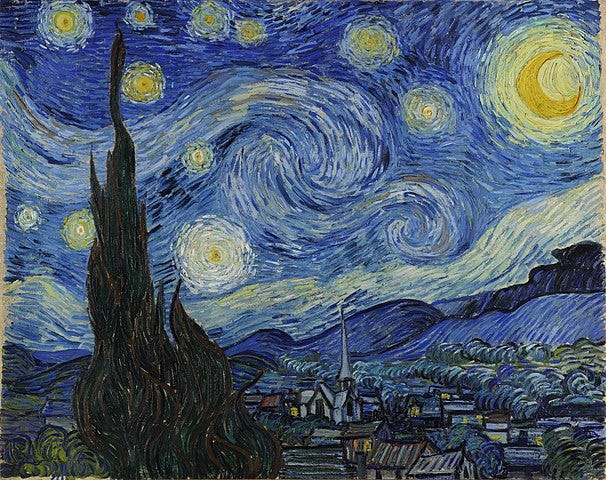
Painting from Van Gohg, Vincent, The Starry Night (1889). Taken from wikipedia commons
With that said, based on our current understanding that nothing can travel faster than the speed of light, the starry sky that poets and painters wondered for millenia is, in reality, a cosmological graveyard of gases and dust by the time their light reaches us.
Assuming light travels in a straight line without any gravitational or other influences, by the time it reaches us, thousands of light years would have already passed.
It is somewhat dazzling to realize that some of the bright stars in the night sky are already gone, vanished, turned into star dust.

James Webb Space Telescope, capturing an exploding sun-like star, now gas and dust, in the Southern Ring Nebula. [this one exploded just a couple thousand years ago!]
The concept of time travel still rests in the realm of fiction as it probably should and likely will stay there for quite some time.
Nevertheless, everything is ever-changing, ever-evolving.
Our limited reality, construed by a newborn taking his first breaths in the cosmological timescale, will be laughed at at some point in time. We may still thrive to be an interplanetary species if all goes well here on Earth.
We may possibly be able to use gravity to bend spacetime and, in a stellar future, take a trip around our galaxy and visit Earth like planets.
Sometimes, I’d really like to enter a wormhole and leave for Andromeda, that’s for sure!